


background swath

Chief Economist Updates

Strong Jobs Report Further Delays Cuts

  • Contributors:
  • Stephen J. Douglass
Monthly Change In Private NFPs

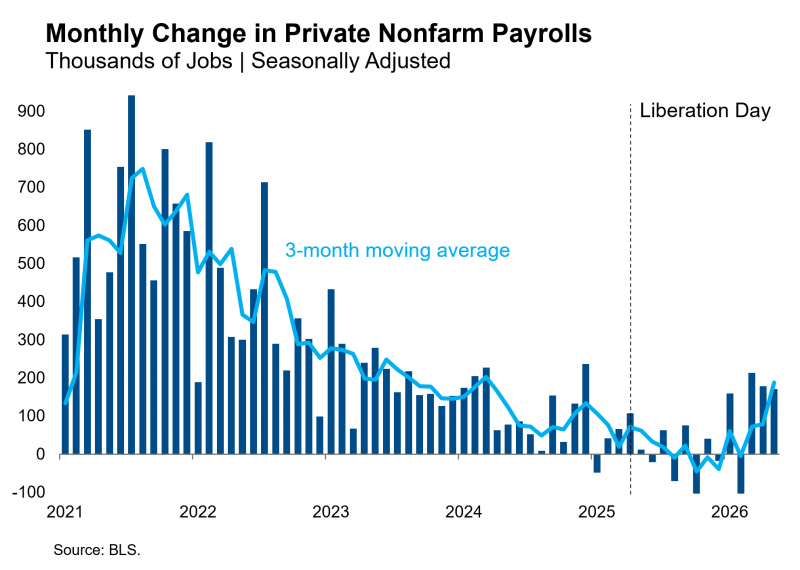
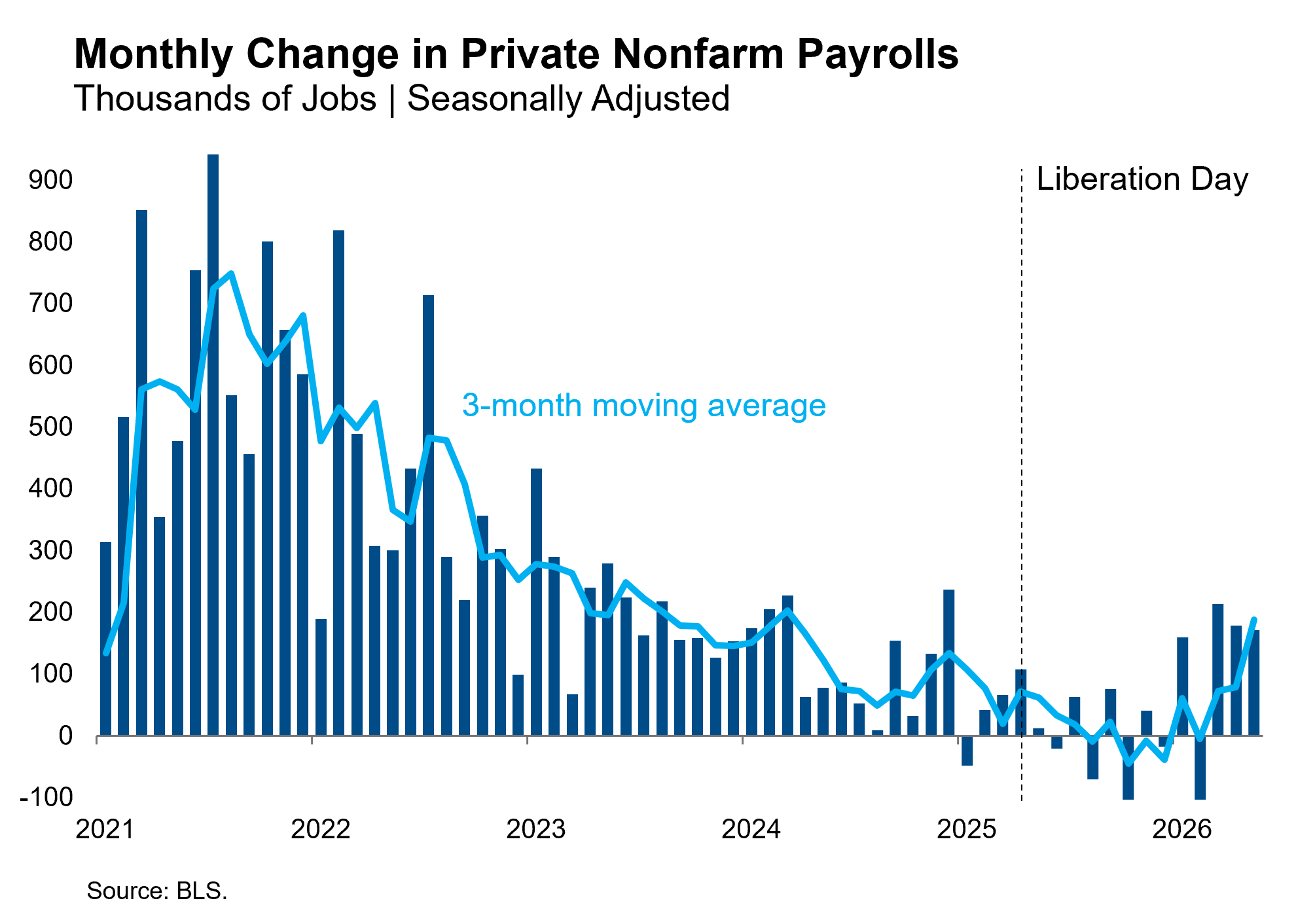
Nonfarm payroll employment surged by 172,000 in a blowout May jobs report, while the prior two months were revised higher by an additional 93,000. The only blemish is that breadth is still a bit narrow. Leisure and hospitality and local government accounted for 125,000 of the job creation in the month. That said, the 1-month diffusion index rose to 54.4% and has remained above 50% every month this year, indicating positive job creation in a majority of the 250 industries in the sample. The upward revisions to job creation (and, by extension, aggregate labor income) in prior months may prompt upward revisions to the low savings rates that have caused us some concern. The 3-month moving average of payroll growth rose to 188,000, which is starting to look like a breakout rather than a stabilization. Job creation appears to have bottomed in the middle of 2025 when trade policy uncertainty peaked.
Monthly Change In Private NFPs

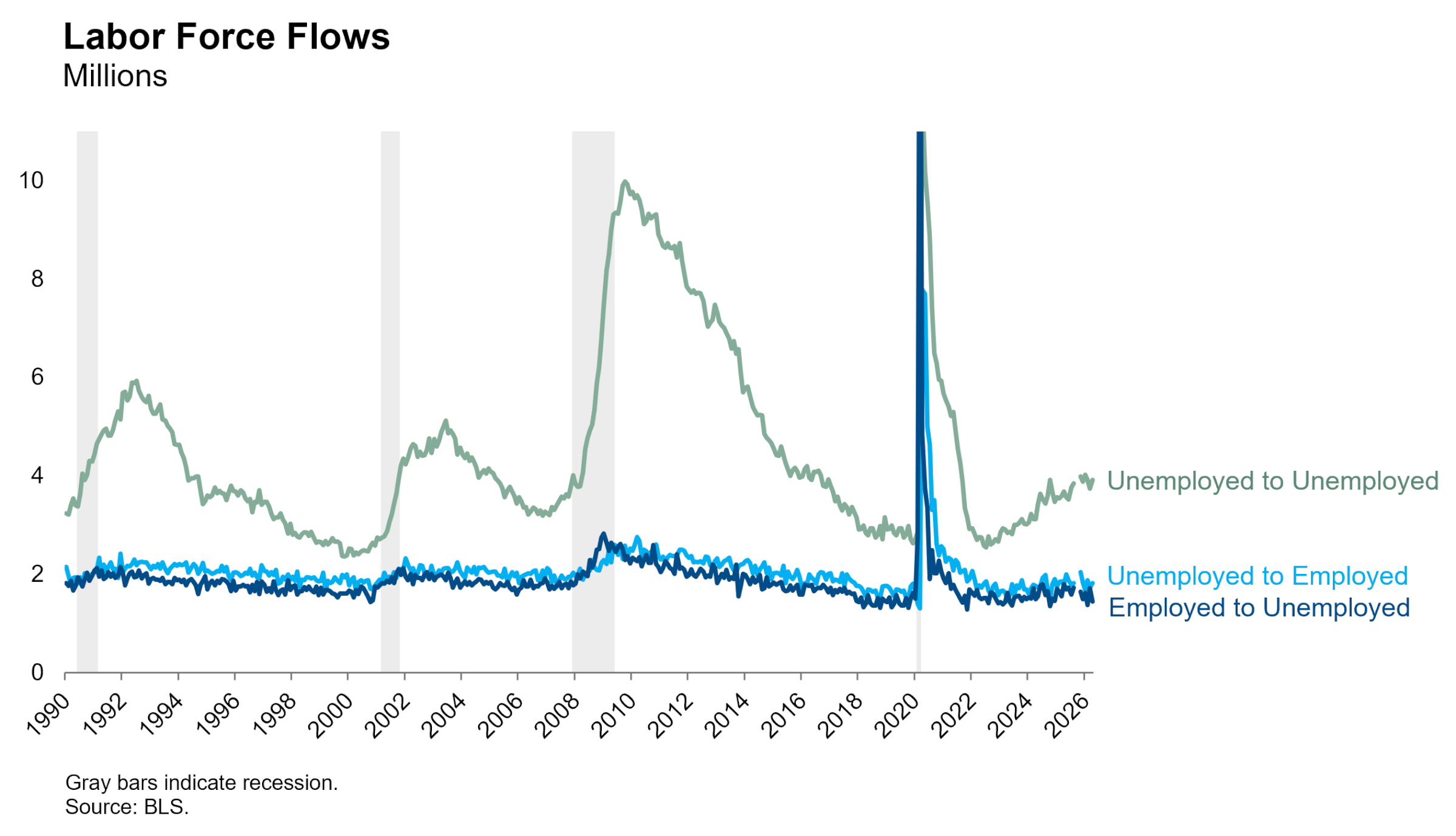
The household survey was also strong: employment in that survey increased by 149,000, the unemployment rate fell by almost half a percentage point to 4.296%, and the participation rate held steady. The number of unemployed persons declined, entirely due to a decline in the number of newly unemployed (<5 weeks). The number of unemployed for more than five weeks rose, so the duration of unemployment increased in the month. The labor force flows and JOLTS data suggest this is still a low-hire, low-fire labor market, but the balance is shifting slightly to allow for faster employment growth. Recall that the U.S. labor market exhibits significant churn underneath the relatively calm surface, with 2-5 million workers transitioning between employment, unemployment and labor force exit in a typical month. Small changes in the rates of these flows can easily translate to a few hundred thousand additional jobs.
Labor Force Flows

Cuts Delayed Further

This report is clearly hawkish for the Fed. Short rate markets added half a hike to the 12-month monetary policy path after the release, now pricing one full hike by December and nearly two by June. We revise our modal expectation from three cuts in December, March and June to two cuts in January and April. Today’s report suggests little urgency to ease monetary policy and argues for a higher neutral rate. It does not, however, suggest a need to tighten policy. The unemployment rate has improved slightly in the last few months but remains nearly a full percentage point above its cycle low. Wage inflation remains well within bounds in this report and in the Employment Cost Index. The labor market is not overheating. We continue to believe that the willingness of some FOMC participants to publicly consider hikes is motivated by a desire to anchor inflation expectations. If the war ends and energy prices decline, that motivation will fade away.

Disclosure Information

By accepting this material, you acknowledge, understand and accept the following:

This material has been prepared by NISA Investment Advisors, LLC (“NISA”). This material is subject to change without notice. This document is for information and illustrative purposes only. It is not, and should not be regarded as “investment advice” or as a “recommendation” regarding a course of action, including without limitation as those terms are used in any applicable law or regulation. This information is provided with the understanding that with respect to the material provided herein (i) NISA is not acting in a fiduciary or advisory capacity under any contract with you, or any applicable law or regulation, (ii) that you will make your own independent decision with respect to any course of action in connection herewith, as to whether such course of action is appropriate or proper based on your own judgment and your specific circumstances and objectives, (iii) that you are capable of understanding and assessing the merits of a course of action and evaluating investment risks independently, and (iv) to the extent you are acting with respect to an ERISA plan, you are deemed to represent to NISA that you qualify and shall be treated as an independent fiduciary for purposes of applicable regulation. NISA does not purport to and does not, in any fashion, provide tax, accounting, actuarial, recordkeeping, legal, broker/dealer or any related services. You should consult your advisors with respect to these areas and the material presented herein. You may not rely on the material contained herein. NISA shall not have any liability for any damages of any kind whatsoever relating to this material. No part of this document may be reproduced in any manner, in whole or in part, without the written permission of NISA except for your internal use. This material is being provided to you at no cost and any fees paid by you to NISA are solely for the provision of investment management services pursuant to a written agreement. All of the foregoing statements apply regardless of (i) whether you now currently or may in the future become a client of NISA and (ii) the terms contained in any applicable investment management agreement or similar contract between you and NISA.

Agree to Terms

Please review and accept the following to proceed. I have read and agree to the Terms of Use, Disclaimer, PSRX Disclaimer and Privacy Policy. I am either (i) an investment professional and an employee of an institutional investor, or a consultant to an institutional investor, or (ii) an employee of, or a student in, an institution of higher learning and I am involved in the study, research or teaching of subjects related to investments, finance, or economics. I reside in the United States or Canada. I understand that the information is not and should not be regarded as investment advice or as a recommendation regarding a course of action. By clicking “Accept” below, you hereby acknowledge, understand and accept the foregoing.