


background swath

Chief Economist Updates

Heavily Distorted CPI Print Reveals Little Useful Information

  • Contributors:
  • Stephen J. Douglass
CPI Inflation Total Core Featured

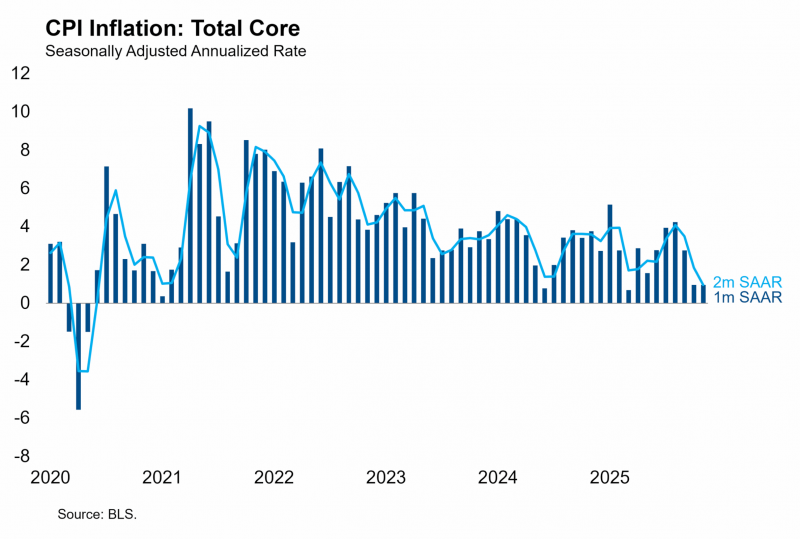
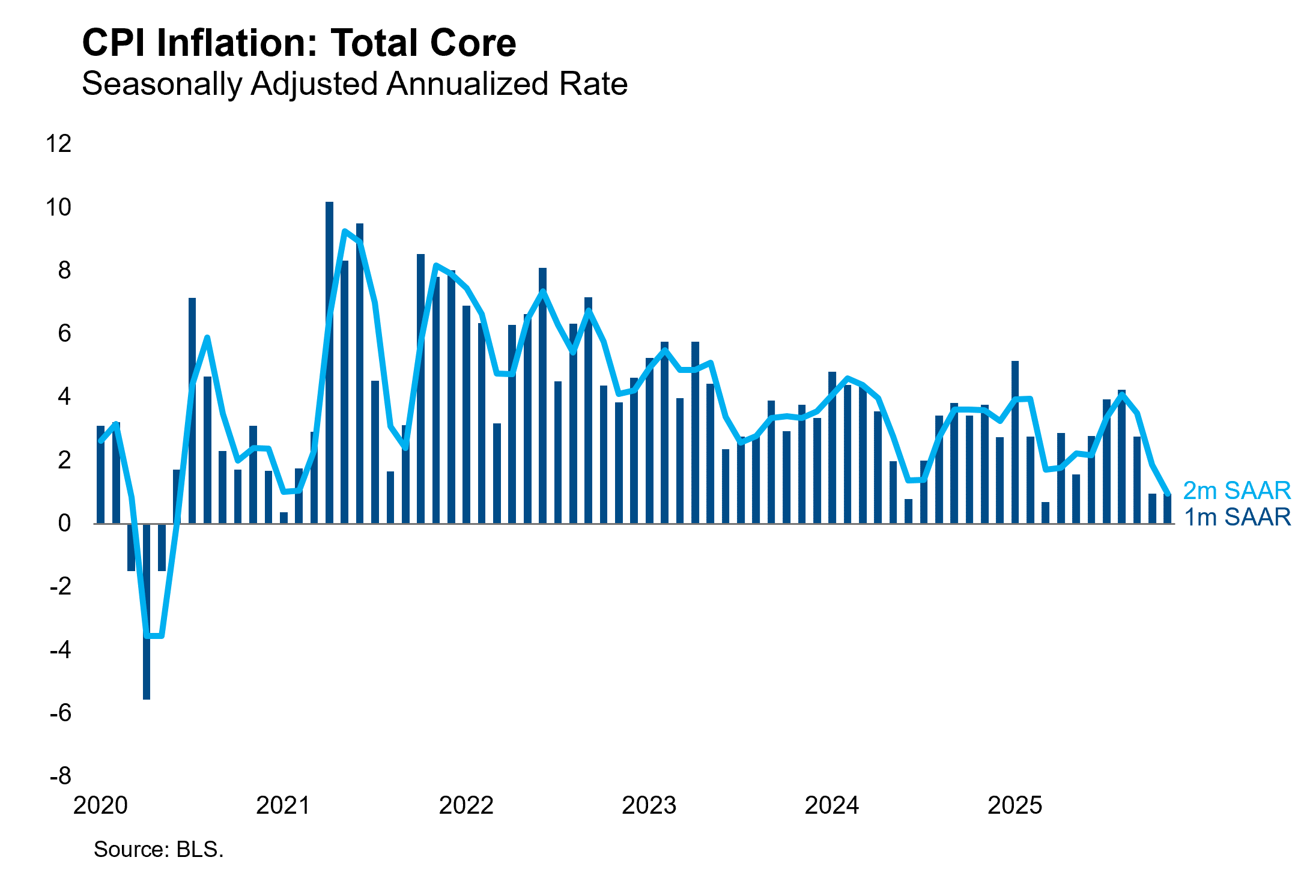
The BLS today released a heavily distorted CPI report that included some information for both October and November. The BLS stopped collecting price data when the government shutdown began on October 1 and did not resume collection until November 14. Because the data are missing, the agency did not publish October index values for most components. The data were therefore primarily presented as two-month changes between September and November. The November figures were based on price data collected during the abbreviated sampling period November 14-30. The results showed a much lower-than-expected rate of inflation. The core CPI index increased by 0.159% over that two-month period, which is the lowest two-month rate since June 2020. In the following charts, we assume the two-month change was evenly spread over October and November. This assumption smooths the monthly figures but has no impact on the two-month figures for November, which are exactly as the BLS reported.
CPI Inflation Total Core

A cycle low in the rate of core CPI inflation would be most welcome news and could clear the way for additional rate cuts in Q1, but the distortions from the shutdown introduce so much uncertainty that we expect the Fed will heavily discount this print. Fortunately, they will get a much cleaner read on the inflation picture when the December data are released on January 13 ahead of the January 27-28 FOMC meeting. We won’t bore you with all the details of the CPI imputation methods, but they probably had to resort to the most extreme “carry forward” imputation method for many components in October, which would simply assume 0% inflation for that month. The BLS did not report their imputation statistics for October, but some of the results suggest this carry forward method was used widely.

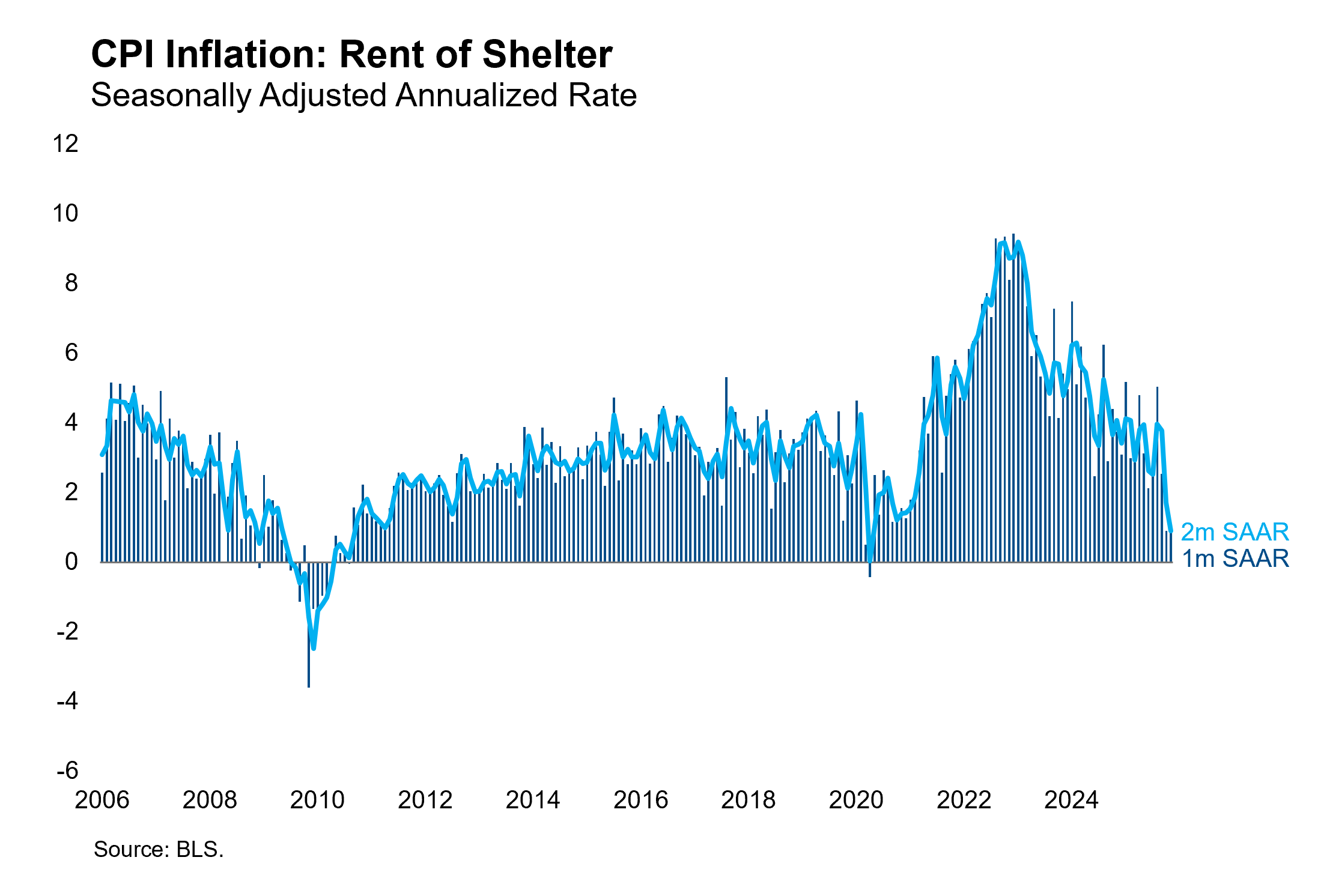
The housing component seems to be one such case. Rent of shelter (includes both apartment rent and owners’ equivalent rent) increased by 0.90% over the two months, which is the smallest two-month increase of the last two decades other than the depths of the pandemic and the global financial crisis. While we expect housing disinflation to continue, a deceleration of this magnitude strains credulity.
CPI Inflation Rent of Shelter

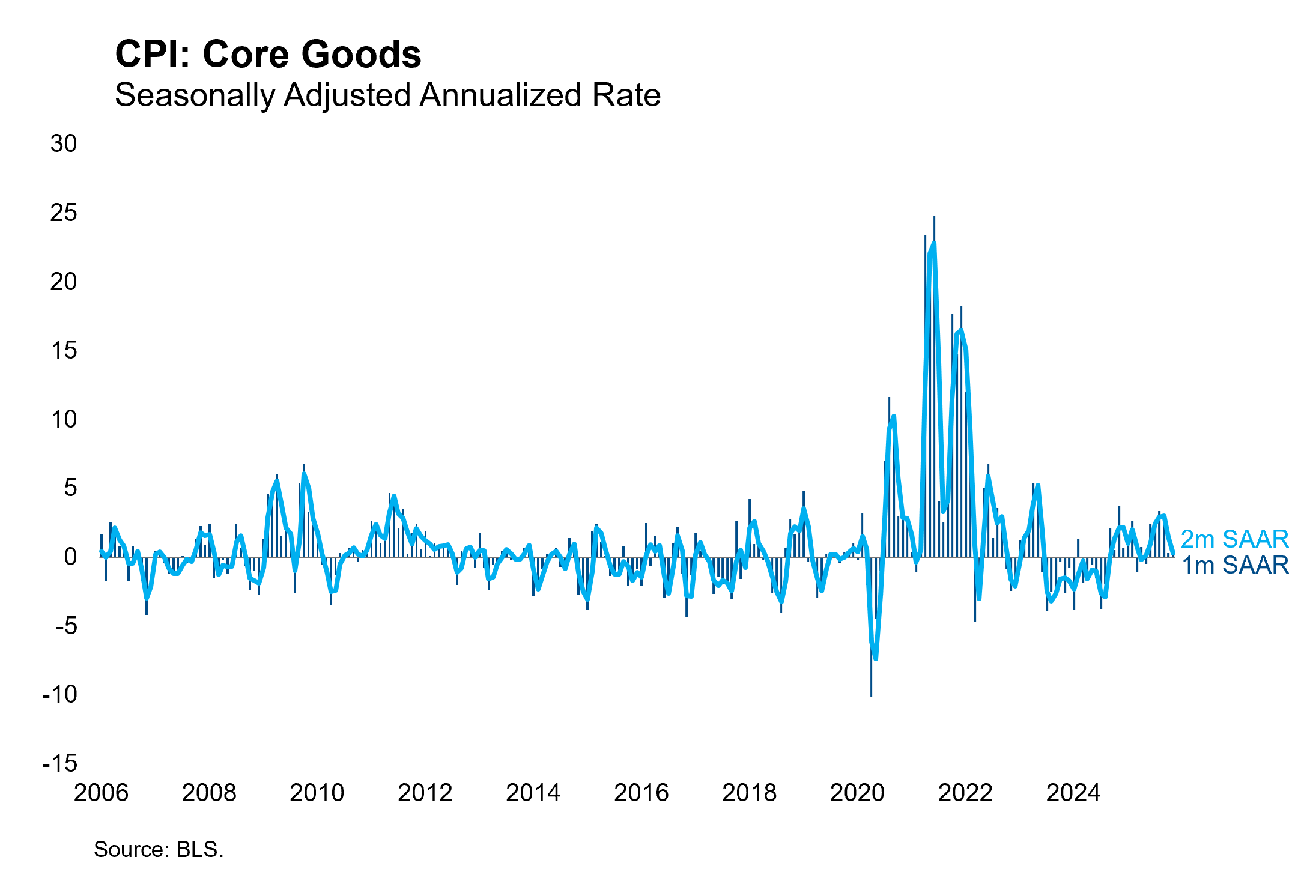
Core goods prices increased by 0.34% in the two-month period, the slowest pace since tariff implementation in May. This figure was probably biased lower because data collection only covered the second half of November when Black Friday sales were underway. The BLS usually samples prices throughout the entire month. While we broadly expect inflationary pressures to peak in early 2026 and then revert back to the soft landing path of 2024, we’ll have to wait for the cleaner December data before we update our assessment of the inflation outlook. We suspect the Fed will do the same.
CPI Core Goods

Disclosure Information

By accepting this material, you acknowledge, understand and accept the following:

This material has been prepared by NISA Investment Advisors, LLC (“NISA”). This material is subject to change without notice. This document is for information and illustrative purposes only. It is not, and should not be regarded as “investment advice” or as a “recommendation” regarding a course of action, including without limitation as those terms are used in any applicable law or regulation. This information is provided with the understanding that with respect to the material provided herein (i) NISA is not acting in a fiduciary or advisory capacity under any contract with you, or any applicable law or regulation, (ii) that you will make your own independent decision with respect to any course of action in connection herewith, as to whether such course of action is appropriate or proper based on your own judgment and your specific circumstances and objectives, (iii) that you are capable of understanding and assessing the merits of a course of action and evaluating investment risks independently, and (iv) to the extent you are acting with respect to an ERISA plan, you are deemed to represent to NISA that you qualify and shall be treated as an independent fiduciary for purposes of applicable regulation. NISA does not purport to and does not, in any fashion, provide tax, accounting, actuarial, recordkeeping, legal, broker/dealer or any related services. You should consult your advisors with respect to these areas and the material presented herein. You may not rely on the material contained herein. NISA shall not have any liability for any damages of any kind whatsoever relating to this material. No part of this document may be reproduced in any manner, in whole or in part, without the written permission of NISA except for your internal use. This material is being provided to you at no cost and any fees paid by you to NISA are solely for the provision of investment management services pursuant to a written agreement. All of the foregoing statements apply regardless of (i) whether you now currently or may in the future become a client of NISA and (ii) the terms contained in any applicable investment management agreement or similar contract between you and NISA.

Agree to Terms

Please review and accept the following to proceed. I have read and agree to the Terms of Use, Disclaimer, PSRX Disclaimer and Privacy Policy. I am either (i) an investment professional and an employee of an institutional investor, or a consultant to an institutional investor, or (ii) an employee of, or a student in, an institution of higher learning and I am involved in the study, research or teaching of subjects related to investments, finance, or economics. I reside in the United States or Canada. I understand that the information is not and should not be regarded as investment advice or as a recommendation regarding a course of action. By clicking “Accept” below, you hereby acknowledge, understand and accept the foregoing.