

 Subscribe
The Treasury Department surprised markets this morning by announcing their intention to at least double the pace of buyback operations in long-end Treasuries, apparently motivated by the steady increase in long-term yields over the past two months. This intervention may flatten the curve in the short term, but it is neither costless nor a permanent solution to the fundamental causes of rising long-term yields.
Buybacks are not QE
A quick note on mechanics, since Treasury’s buyback program may not be familiar to all readers. Treasury Department buybacks and Fed QE operations look very similar in that both involve buying Treasuries in the secondary market (and both are, in fact, executed by the same Open Market Desk at the New York Fed). The key distinction is that QE purchases are funded by the Fed printing money while buybacks are funded by Treasury issuing new debt. Buybacks are significantly less potent than QE because buybacks require Treasury to issue new bonds in order to purchase old bonds.
If buybacks were duration neutral as they were originally designed to be (i.e., buybacks in each sector were funded with new issuance in that same sector), then they would not change the average level of interest rates, and their impact would be limited to relative value spreads between on-the-run and off-the-run Treasuries. Treasury has now dropped the pretense of duration neutrality. We expect these increased purchases of long Treasuries will be funded by issuing more Treasury bills. This is an operation twist conducted by the Treasury Department and has the same practical effect as issuing more bills to reduce long-end issuance. We now expect that Treasury will reduce auction sizes of 20y and 30y bonds at an upcoming refunding meeting.
A More Activist Treasury Department
The current pace of long-end buybacks is $16 billion per quarter, split evenly between the 10-20y and 20-30y sectors. The doubling announced today will increase the pace from $64 billion annually to at least $128 billion. This is a meaningful increase relative to the $444 billion of combined 20y and 30y issuance per year but is a drop in the bucket relative to the $6.99 trillion in bills outstanding (all of which must be refinanced within 12 months by definition). We don’t anticipate that the expected increase in supply will cause bills to cheapen materially versus other short-term interest rates like fed funds and SOFR, but we’ll be watching this variable closely in the days and weeks ahead.
When the yield curve is upward sloping, Treasury can indeed lower their average borrowing cost by shortening the maturity of their issuance. The tradeoff is that shortening maturity increases the variability of borrowing cost. This is the age-old tradeoff faced by government debt managers and corporate bond issuers alike: is it better to borrow at lower cost today and bear refinancing risk, or lock in longer maturity financing at a higher cost? The answer is only revealed ex post as the future path of short-term interest rates is realized. Over the last four decades, Treasury has balanced this tradeoff by communicating a regular and predictable path of issuance that seeks to satisfy all sources of demand without resorting to market-timing. Treasury’s credibility on that regular and predictable issuance mantra took a hit today.
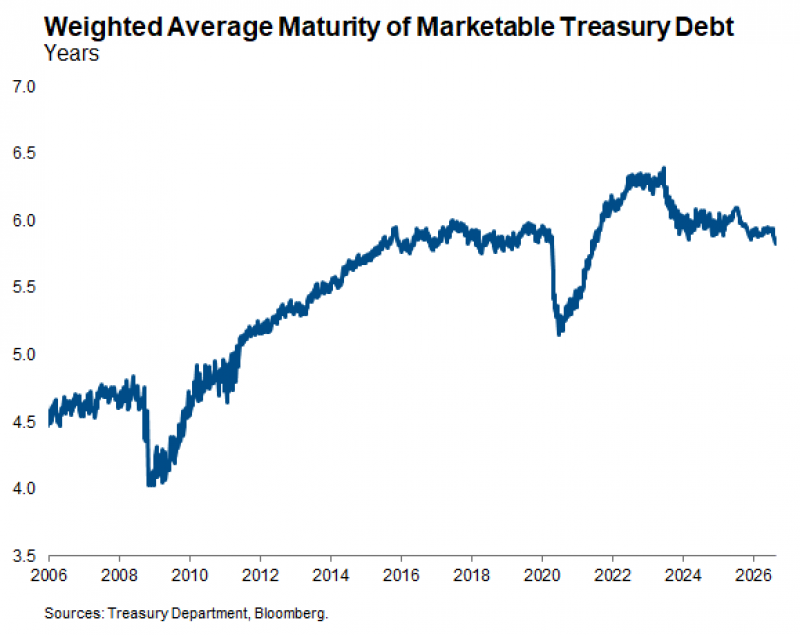
The other cost of this maturity shortening exercise is increased refinancing risk. Bessent is well aware of this risk, since he criticized Secretary Yellen publicly and his hedge fund investors for doing the exact same thing in 2023-2024. The weighted average maturity of marketable Treasury debt outstanding has declined by more than half a year since May 2023 as Yellen and Bessent increased bills from 16% to 22% of debt outstanding.
Buybacks Don’t Change the Fundamentals
We would argue that the increase in Treasury yields over the last two months has been driven primarily by the inflationary risk from rising oil prices amidst a backdrop of surging hyperscaler debt issuance and the steady march higher in the fiscal risk premium. Buybacks are inconsequential relative to these fundamental forces. An extra $64 billion of buyback purchases over the next 12 months isn’t going to do much when Treasury and corporate America will borrow around $3 trillion net between them over the same time period. Those borrowing needs are unlikely to change in the near term, so the surest path back to 30-year yields below 5% would be to get oil prices back below $75 per barrel by ending the Iran war or otherwise tilting the balance of oil supply and demand. That would allow inflation to revert to its underlying trend (which is relatively benign in our opinion) and preclude the need for the Fed to hike rates.
As the war continues and oil prices remain high, Secretary Bessent has pulled one of the levers at his disposal. The most important lesson from today is that Bessent has embraced activist Treasury issuance as a strategy to prevent rising long-term Treasury yields. This intervention may flatten the curve for a time, but activist Treasury issuance is unlikely to offset the fundamental factors pushing Treasury yields higher. And the cost to taxpayers is a more uncertain cost of borrowing in the years ahead.