





As we saw with SpaceX in June, a number of larger IPOs on the horizon could drive single-stock hedging demand from allocators. While there are various ways to hedge, option markets were quick to develop and have often been the preferred hedge expression, with zero-premium collars[1] being particularly popular. Investors may be surprised by the pricing of zero-premium collars on recent IPOs, as pricing tends to reflect a positive skew (the call strike sold is further out-of-the-money than the put strike purchased), and the asymmetry can be significant. This is in sharp contrast to index option pricing, which frequently exhibits negative skew (the call option strike is closer to the spot than the put strike).
Strike asymmetry is common in single-name equities and even more so in those with higher implied volatilities. We anticipate that future mega-cap IPOs are likely to exhibit similar dynamics. The most significant driver is the combination of elevated implied volatility and the properties of the lognormal distribution, the standard framework for modeling equity price returns.
The following characteristics all contribute to this asymmetry:
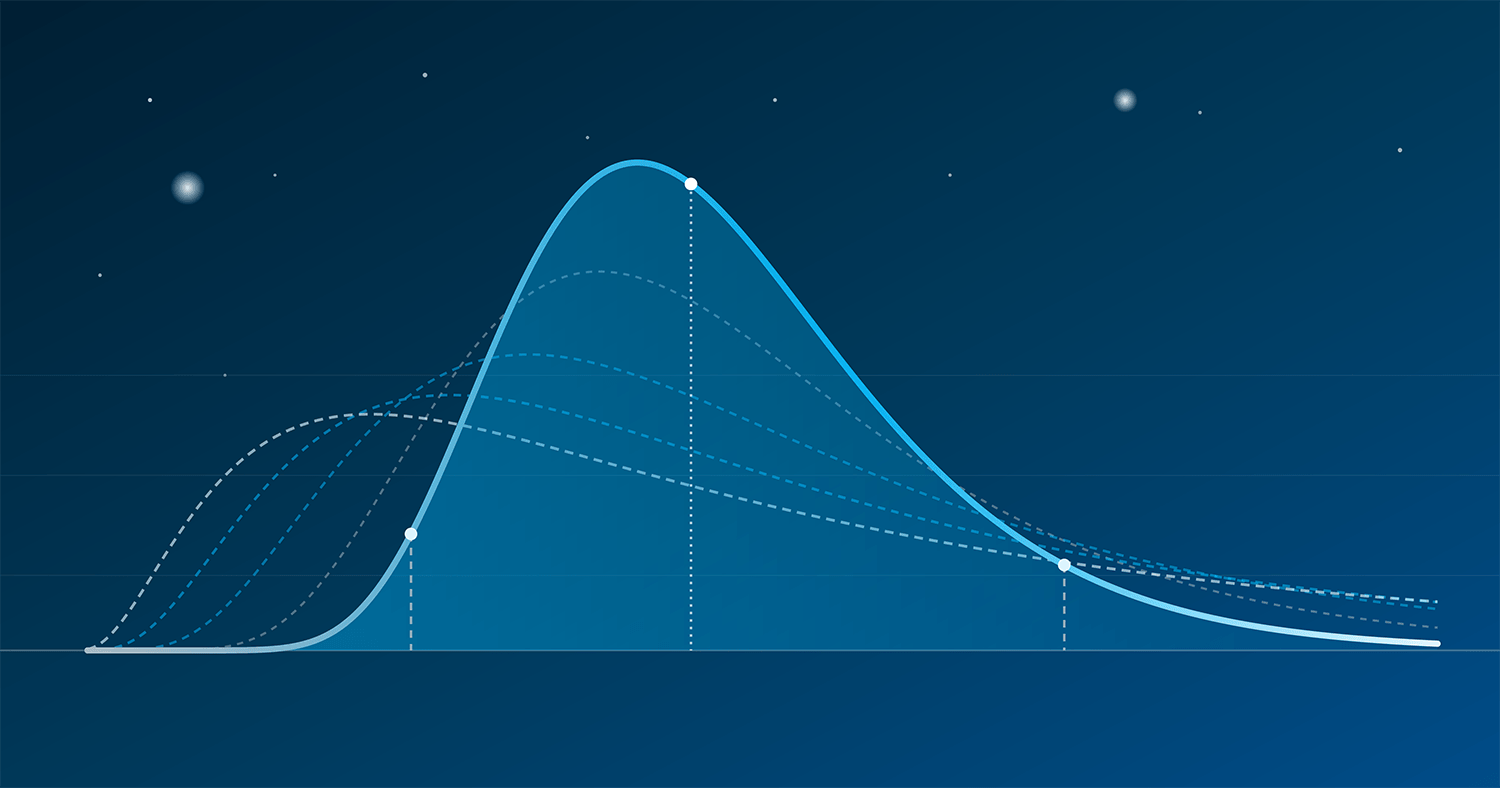
- The lognormal distribution inherently having a positive skew due to the properties of multiplicative returns and being bounded below by zero.
- Lognormal skew increasing significantly with volatility.[2]
- Zero or low dividend yields resulting in a forward that is higher than spot.
Collectively, these properties produce a distribution with a fat right tail, in which the magnitude of upside scenarios in dollar terms exceeds that of equidistant downside scenarios. This effect is amplified by volatility, as volatility rises, the right tail extends further, so in zero-premium collar structures, the call strike can move further away from spot relative to the put strike.
A note on the asymmetry: while the asymmetry can be stark relative to spot, it is more muted relative to the forward. As outlined above, zero or low dividend-paying assets will have a forward higher than spot in a positive interest rate environment. This feature will make the upside call strike closer to “at-the-money” in forward space and likewise the put further “out-of-the-money”; therefore, the positive strike skew will have a smaller differential in forward space.
The interactive tool below demonstrates how volatility can affect zero-premium collar pricing.
Stylized example of option mechanics, not live pricing and not indicative of any NISA strategy, position or result.[3]
Other factors such as expiry, the risk-free rate, the borrow rate and the volatility skew (the shape of the volatility surface) influence the implied distribution and consequently collar pricing. The forward price is a function of the risk-free rate, dividends and the borrow rate. IPO shares can initially be difficult to borrow, leading to elevated borrow rates, which will decrease the forward and be a headwind for zero-premium collar pricing. The volatility skew describes the implied volatility surface of an asset, assigning different volatilities by strike. When volatility skew is “flat,” the implied volatility differential between the put and call options is smaller, meaning a further out-of-the-money call can fund a closer put strike. Single-name equities often exhibit a flatter volatility surface than index options, which works to the advantage of zero-premium collar pricing.[4]
The tool below includes additional factors to illustrate their impact on zero-premium collar pricing. We have assumed a “flat” volatility skew for simplicity (i.e., all options are assumed to have the same implied volatility, resulting in a perfectly lognormal distribution).
Stylized example of option mechanics, not live pricing and not indicative of any NISA strategy, position or result.[3]
We anticipate that option markets for future IPOs are likely to exhibit characteristics like what was experienced in SPCX: high volatility and relatively flat volatility skew. The asymmetric pricing of zero-premium collars does not represent market mispricing or an inherent opportunity, but rather reflects the pricing dynamics of options. Nonetheless, this asymmetry is optically appealing to investors looking to hedge their exposure using zero-premium collars; the structure limits downside risk while maintaining upside exposure up to the call strike. We expect option collars to remain a popular alternative with investors looking to hedge volatile IPO exposures.
[1] A zero-premium collar consists of a bought put and a sold call such that the package price is zero; by selling an upside call option, the investor gives up any gains in the underlying asset beyond the call strike.
[2] The skew of a lognormal distribution is 
[3] Disclaimer: The interactive tools herein are simplified, hypothetical illustrations; their outputs depend on user-selected inputs and assumptions, do not represent live pricing/costs/market conditions, and are not indicative of any NISA strategy, account or result. NISA does not warrant that the functions contained in this tool will meet the user’s specific requirements, or that the tool will be error-free, or that there will be no inaccuracies. User acknowledges that third-party data may have been used in the creation of the tool. NISA makes no representations or warranties as to the accuracy of such data and specifically disclaims all responsibility and liability with respect to any such third-party data, use of this tool, and any information and/or results obtained through the use of the tool. Use of the tool is at the user’s own risk.
[4] Implicitly, the flatter volatility surface for single-name options suggests that index option pricing reflects increasing correlations across individual equities as markets decline, a key driver of negative skew observed in broader equity exposure.