




background swath

Perspectives

Not All Gains Escape Gravity: A Look at IPO Lockup Risk

  • Contributors:
  • Christin Hinkle
  • ,
  • Paul Oehrlein, CFA
RocketDeclineImage

With the landmark SpaceX IPO in June and several additional mega-cap issuances anticipated over the next year, NISA has observed significant interest around the mechanics and market implications of large-scale public offerings. Considering SpaceX had a market cap of nearly $3 trillion, this single investment represented a material portion of private equity exposure for many investors. Particularly those with sizable co-investments, SpaceX accounted for a significant portion of their overall asset value. Investors have been concerned with the outsized idiosyncratic risk associated with the concentrated positioning and share price volatility, resulting in significant hedging demand. We anticipate similar dynamics for future mega-cap IPOs.

While risk considerations have been the primary driver of hedging demand, the dynamics surrounding IPO lockup provisions and their effect on share price are another key factor. At the time of listing, a portion of shares (sometimes meaningful) remains subject to lockup restrictions. These shares are contractually restricted from being sold into the open market and are excluded from the initial float. This creates a supply constraint at listing, where the shares available to secondary market participants represent only a fraction of the company’s total ownership, with the potential for additional supply in the future.

Lockup periods are contractually defined, typically ranging from 90 to 180 days from the IPO date, and in some cases can be staggered over time. These shares are generally held by insiders, pre-IPO investors and employees who received equity as part of their compensation. Because lockup expiration dates are publicly known and disclosed in offering documents, they represent a liquidity event that market participants can observe and trade around in advance. An analysis of 543 common stock IPOs from January 2019 to December 2025 finds that share prices underperform the S&P 500 by an average of 20.4% between the closing price on the first trading day and the lockup release date, as market participants sell shares in anticipation of incremental supply coming to market after lockup expiry. Keep in mind that this does not reflect any price appreciation that occurs between the IPO price and the close of business on the first trading day. In the case of SpaceX, the IPO price was $135 and the stock closed on its first trading day at $160.95, an appreciation of ~19%. However, as of July 27, SpaceX has fallen to $113.50, a ~29% decline from the close of the first trading day.
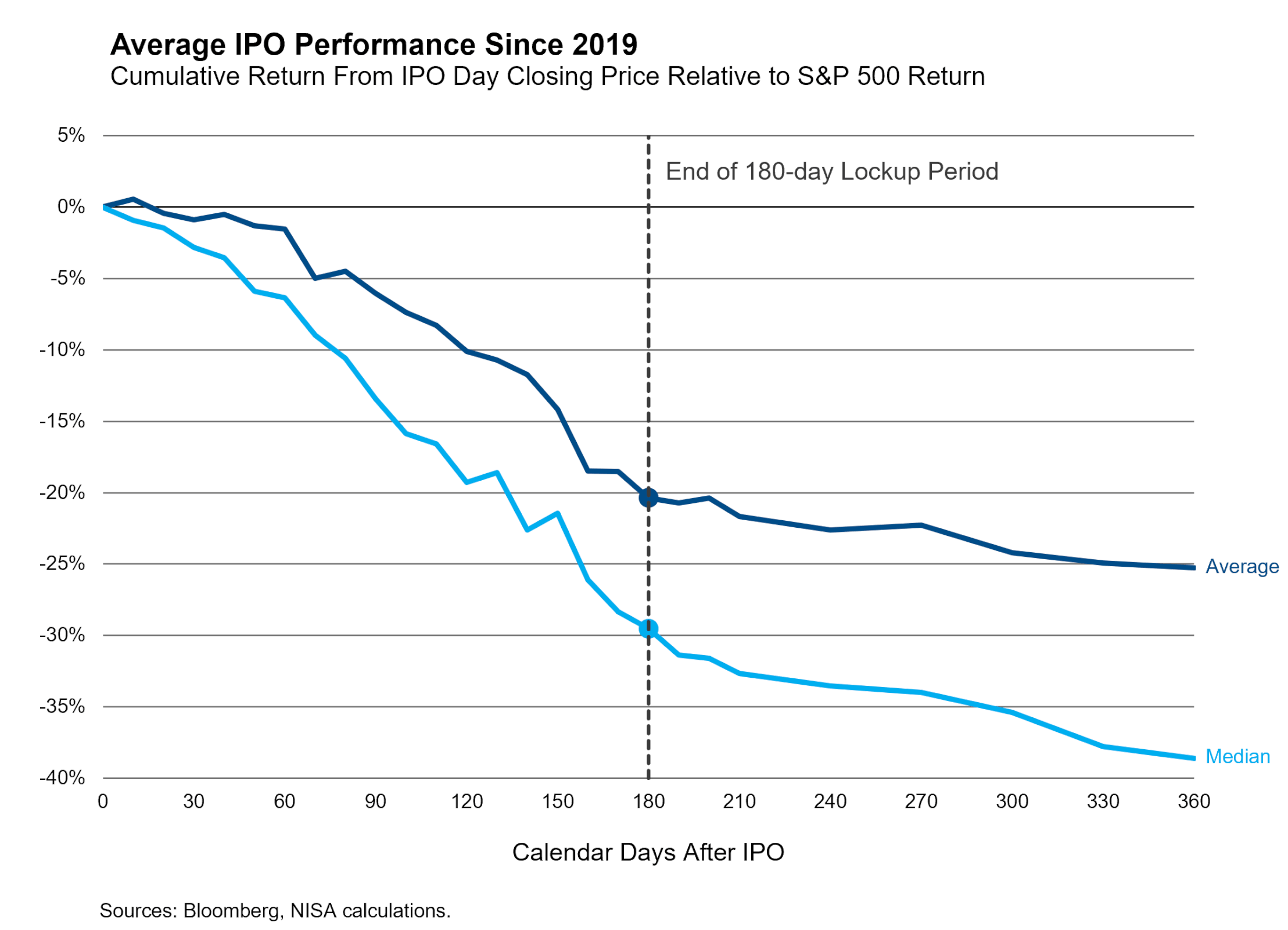
Average IPO Performance Graph

For investors looking to hedge SPCX exposure, derivative markets developed quickly after the IPO, providing various opportunities for clients to hedge exposure. These include both OTC and listed options markets, as well as total return swaps or direct shorting of shares through a prime brokerage relationship.

For investors who have made long-term venture and private equity investments, having an exit plan independent of their GP, when permissible, is critical to ensuring gains that may have accrued over the years are risk-managed throughout their exit.


PDF Image Preview

A Look at IPO Lockup Risk

Download File

Disclosure Information

By accepting this material, you acknowledge, understand and accept the following:

This material has been prepared by NISA Investment Advisors, LLC (“NISA”). This material is subject to change without notice. This document is for information and illustrative purposes only. It is not, and should not be regarded as “investment advice” or as a “recommendation” regarding a course of action, including without limitation as those terms are used in any applicable law or regulation. This information is provided with the understanding that with respect to the material provided herein (i) NISA is not acting in a fiduciary or advisory capacity under any contract with you, or any applicable law or regulation, (ii) that you will make your own independent decision with respect to any course of action in connection herewith, as to whether such course of action is appropriate or proper based on your own judgment and your specific circumstances and objectives, (iii) that you are capable of understanding and assessing the merits of a course of action and evaluating investment risks independently, and (iv) to the extent you are acting with respect to an ERISA plan, you are deemed to represent to NISA that you qualify and shall be treated as an independent fiduciary for purposes of applicable regulation. NISA does not purport to and does not, in any fashion, provide tax, accounting, actuarial, recordkeeping, legal, broker/dealer or any related services. You should consult your advisors with respect to these areas and the material presented herein. You may not rely on the material contained herein. NISA shall not have any liability for any damages of any kind whatsoever relating to this material. No part of this document may be reproduced in any manner, in whole or in part, without the written permission of NISA except for your internal use. This material is being provided to you at no cost and any fees paid by you to NISA are solely for the provision of investment management services pursuant to a written agreement. All of the foregoing statements apply regardless of (i) whether you now currently or may in the future become a client of NISA and (ii) the terms contained in any applicable investment management agreement or similar contract between you and NISA.

Agree to Terms

Please review and accept the following to proceed. I have read and agree to the Terms of Use, Disclaimer, PSRX Disclaimer and Privacy Policy. I am either (i) an investment professional and an employee of an institutional investor, or a consultant to an institutional investor, or (ii) an employee of, or a student in, an institution of higher learning and I am involved in the study, research or teaching of subjects related to investments, finance, or economics. I reside in the United States or Canada. I understand that the information is not and should not be regarded as investment advice or as a recommendation regarding a course of action. By clicking “Accept” below, you hereby acknowledge, understand and accept the foregoing.