


Literacy rates may not drive asset allocation decisions this quarter, but we’re all invested in America’s public school system. The deficiencies of that system lead to a less productive workforce, slower growth, greater inequality and a narrower path to solving our fiscal problems. We’d even argue that these dynamics put downward pressure on the real neutral interest rate and, consequently, long-term Treasury yields.
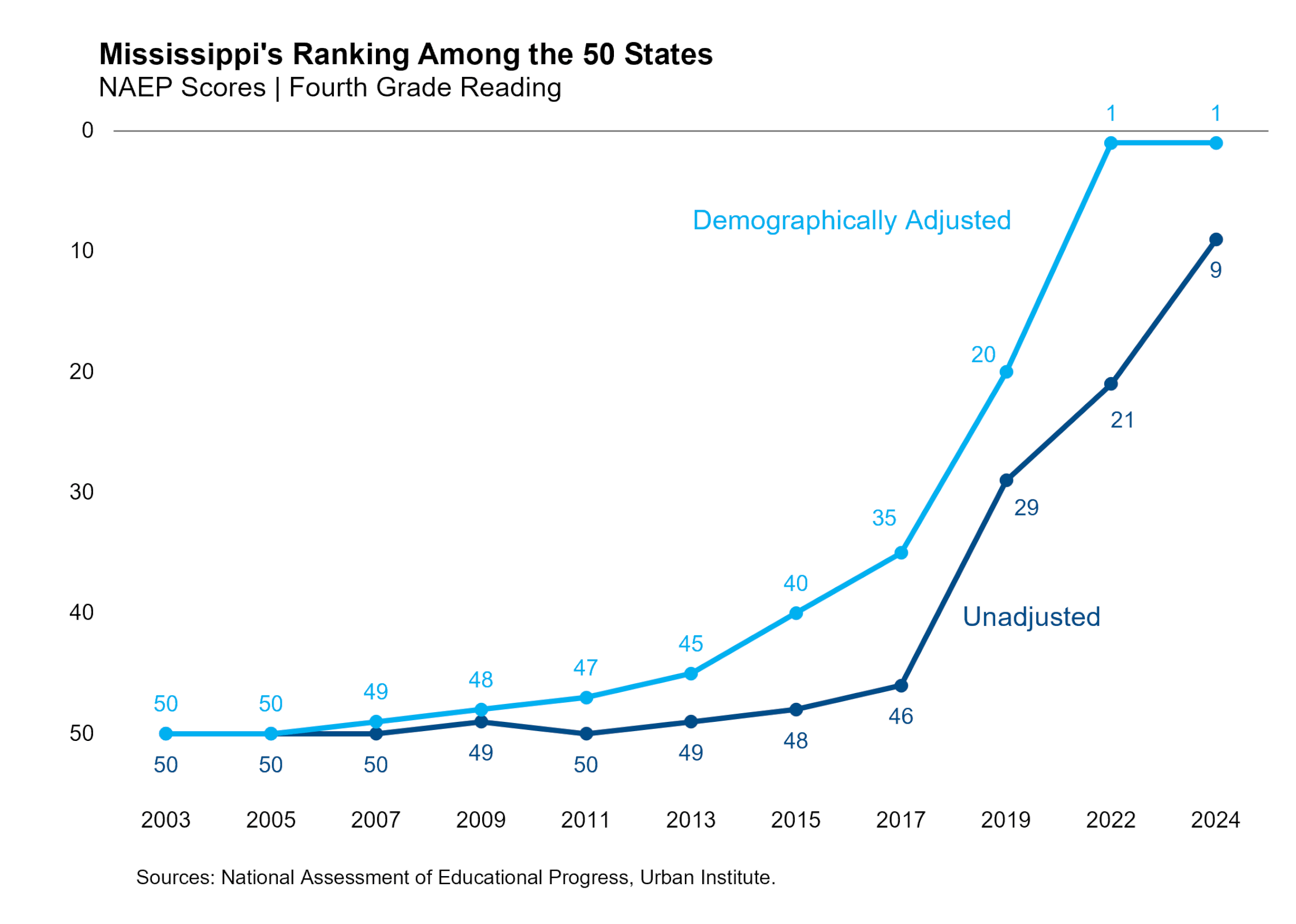
Thankfully, the state of Mississippi is here to provide a glimmer of hope that this Gordian knot of a policy challenge is solvable. Starting with the 2013 Literacy-Based Promotion Act (LBPA), the Magnolia State has overhauled its approach to early childhood literacy education and rocketed past its peers. In just 11 years, Mississippi’s state ranking has risen from 49th place to 9th place for fourth grade reading scores on the National Assessment of Educational Progress (NAEP). Mississippi ranks dead last among the 50 states in terms of income per capita, public health outcomes, racial inequality and single parenthood rates. When adjusting for these demographic disadvantages, the results could not be any better: the state’s demographically adjusted ranking improved from worst to first in one generation.
Successful public policy action requires tradeoffs. Most elements of the reform—a reading curriculum that emphasizes phonics, specialized teacher training and intensive interventions for struggling K-3 readers—are widely supported. These additional resources have not required a significant increase in spending—Mississippi’s per pupil spending has remained around 75% of the national average before and after the reforms. The most controversial element of LBPA is the requirement that schools hold back third graders who fail multiple reading proficiency exams, with exemptions for children in challenging circumstances. Mississippi has held back about 8-9% of third graders in recent years. Studies suggest these retained students enjoy substantially better outcomes, and a policy of advancing unprepared students doesn’t strike us as a better alternative.
We’ll leave it to education policymakers to debate these particulars and optimize the reform agenda. In the meantime, Mississippi has proven that the obstacles to education reform are surmountable. For that, we can all be grateful.