

Quarterly Market Webinar
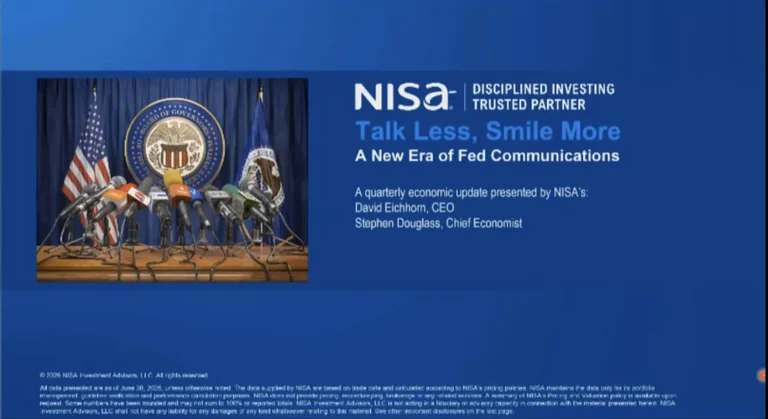
Talk Less, Smile More: A New Era of Fed Communications
Webinar Synopsis

Chief Executive Officer

Chief Economist
Just as the economy seemed poised to put the energy shock behind it, a re-escalation of the war in Iran has pushed oil prices higher and clouded the outlook, all while a new Fed chair begins to reshape how the central bank talks to markets.
In this discussion:
- The latest inflation data and the renewed energy shock
- Why a rate hike makes little sense, and whether cuts are needed at all
- Chair Warsh’s push for a less communicative Fed and the history of forward guidance
- What less guidance could mean for market volatility, plus the outlook for 2027
The inflation picture beneath the oil shock.
Oil climbed back above $80 as the Iran conflict re-escalated, just weeks after dipping below $70. Still, the underlying trend remains encouraging: core CPI turned negative month-over-month in June, and core goods prices have now fallen for two straight months, a sign that tariff-driven inflation has fully passed through. The labor market has stabilized after an unusual run of negative payroll prints, and productivity is running a full point above the last expansion, giving the economy room to absorb faster wage growth without reigniting inflation.
Rates and the case against hiking.
Eichhorn and Douglass agree that hiking into a supply-side oil shock would be a policy mistake, even though markets briefly priced near 50/50 odds of a July hike. They view June’s hawkish dots as largely performative, a cheap way for the Fed to signal resolve without tightening. Cuts are another matter: with growth above 2% for three straight years despite a funds rate above 3.5%, the economy may not need much more easing. Douglass sees room for one or two cuts in 2027, while Eichhorn is more skeptical, cautioning that cuts absent a recession could look more like pandering than sound policy.
A new communications era under Chair Warsh.
Much of the conversation centers on Warsh’s move toward a quieter Fed. His first FOMC statement was the shortest since 1994, reversing three decades of steadily increasing transparency. Using the 2011 “no hikes for two years” guidance and the belated pivot of 2021 as case studies, the two debate when forward guidance helps and when it boxes the Fed in. With the Fed not having truly surprised markets since 1992, they expect less guidance to bring higher rate volatility and possibly higher risk premiums if markets lose sight of the Fed’s reaction function. Still, the heavyweight roster of economists on Warsh’s new advisory task force suggests a genuine effort at reform rather than a stalling tactic.
More Webinars

March 8, 2026
Webinar Title
Just when a soft landing seemed within reach, the war in Iran has sent energy prices surging and introduced a fresh wave of uncertainty for businesses and consumers alike.
Partner With NISA